DIESEL VS. PETROL ENGINES: WHAT SETS THEM APART?
At a high level, diesel and gasoline engines share quite a bit in common. Both fall under the category of internal combustion engines (ICEs), engineered to transform the chemical energy stored in fuel into mechanical energy. This mechanical energy drives the pistons up and down within the engine cylinders. Connected to a crankshaft through connecting rods, these pistons generate the rotary motion that ultimately propels the vehicle.
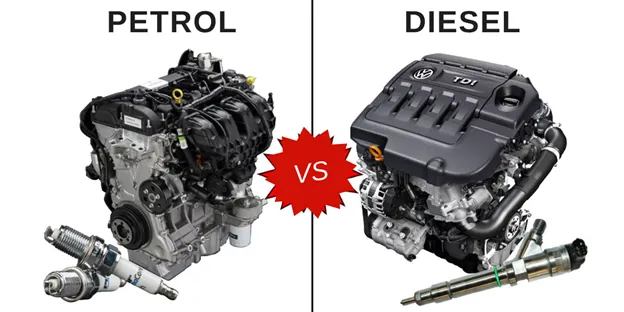
Both engine types, then, rely on a sequence of explosions (combustions) to convert fuel into mechanical energy — but the manner in which those combustions are triggered is where they diverge. Gasoline engines mix fuel with air first, then compress that mixture and ignite it using sparks from spark plugs. Diesel engines take a different approach: air is compressed first, and the heat generated by that compression causes the fuel to ignite when it is introduced.
This guide covers everything you need to know about how diesel and gasoline engines work, differ, and compare.
At a fundamental level, petrol and diesel fuel injection systems operate on roughly the same principles. Both are internal combustion engines that convert chemical reactions into mechanical energy, and both rely on pistons moving inside cylinders to compress the fuel-air mixture before ignition.
Both engine types operate on a four-stroke combustion cycle — the intake stroke, the compression stroke, the combustion stroke, and the exhaust stroke. For a deeper look at how each of these stages works, refer to our recent article comparing two-stroke and four-stroke engines.
Several interconnected systems are critical to the operation of internal combustion engines. The most important ones are outlined below.
A typical fuel injection system is divided into low-pressure and high-pressure sections. The low-pressure side includes the fuel tank, fuel supply pump, and fuel filter. The high-pressure side comprises the high-pressure pump, the fuel injector, and the fuel injector nozzle.
Fuel remains stored in the fuel tank until the vehicle requires it. At that point, the low-pressure components take over. The fuel supply pump moves fuel from the tank to the fuel injection pump.
The fuel injection pump must deliver a carefully measured quantity of fuel into the injector at high pressure.
From the fuel injection pump, the fuel travels to the cylinders via a fuel injector. A key element of that injector is the nozzle, which is the point through which fuel enters the cylinder.
Fuel filters are constructed from cellulose or synthetic fibers. Their function is to block particles and water from entering the fuel injection system, thereby reducing the risk of engine wear and contamination.
So what distinguishes the fuel systems of diesel and gasoline engines from one another?
The fundamental distinction lies in how energy is generated. Diesel engines compress the air before fuel is introduced, whereas petrol engines mix air and fuel together, then compress and ignite the combined mixture.
The type of fuel itself is another point of difference. Diesel is denser than gasoline, which means it evaporates more slowly. It produces lower quantities of CO2 and methane, but generates higher levels of harmful nitrogen compounds.
The internal combustion engine contains many moving mechanical components that must be continuously lubricated. Among these are crankshaft bearings, connecting rod bearings, valve mechanisms, valve timing chains, the camshaft, and the interface between the piston and the cylinder wall.
This is where the lubrication system comes in, supplying each of these parts with the appropriate volume of engine oil. The primary components of a lubrication system include an oil pump, oil filters, an oil sump, an oil cooler, and an oil manifold.
To distribute engine oil to all necessary components, the oil tank incorporates a sump (oil pan) at the lower end of the lubrication system. Oil is then routed through the engine using either the splash system or the full pressure system. Oil filters keep contaminants out of the engine oil.
Engine oil is formulated with sophisticated additive packages designed to minimize friction between moving parts, lubricate metallic engine components, and limit wear and tear. Every engine oil in Valvoline's product range is built on the highest-quality base oils combined with advanced additive formulations. Among our most widely used options are SynPower Premium, Max-Life High Mileage, and All Climate Year-Round engine oils. Not sure which suits your petrol or diesel vehicle best? Our Lubricant Advisor is ready to help.
Whether it runs on petrol or diesel, the internal combustion engine in your vehicle generates significant heat. Left unmanaged, that heat can cause severe engine damage and lead to expensive repairs. For this reason, every internal combustion engine is equipped with a cooling system.
The engine's cooling system serves multiple purposes: it cools the engine cylinders, reduces the temperature of the lube oil, and cools the combustion air. Key components include a coolant pump, a radiator, a heat exchanger, a thermostat, and coolant filters.
The cooling system's primary job is to circulate coolant and shield engine components from damage at extreme temperatures. Beyond preventing the liquid from freezing or boiling over, the coolant also provides deterrent, anti-oxidation, and anti-corrosion benefits. Known as antifreeze, this coolant is a blend of coolant concentrate and distilled water in a proportion that varies depending on the engine's operating conditions.
The coolant travels in a continuous loop. A water pump pushes it through the engine, where it flows through water jackets — channels that allow the coolant to absorb heat from the ICE. A thermostat valve monitors coolant temperature, and when the fluid becomes too hot, it redirects the coolant to the radiator. The hot coolant enters the radiator through hoses, cools down there, and is then pumped back into the engine to repeat the cycle.
Coolants are categorized by their chemical makeup into inorganic types (IATs) and organic types (OATs). Several hybrid formulations also exist, including HOATs, P-HOATs, and Si-OATs. Each category employs a distinct inhibitor technology and exhibits unique properties. Choosing the right product for your vehicle's cooling system is therefore essential. Valvoline offers the broadest range of advanced cooling solutions for passenger cars, heavy-duty vehicles, recreational marine applications, and motorcycles.
An aftertreatment system is a device designed to reduce the harmful exhaust emissions produced by internal combustion engines. Found in both diesel and petrol vehicles, it helps expel excess combustion gases from the engine through the tailpipe.
A standard diesel exhaust system includes a particulate filter, a catalytic converter, and a muffler. Here is what you need to know about each component:
Modern advanced aftertreatment systems demand the use of lower SAPS oils — oils with restricted levels of sulfur and phosphorus. Look for TWC-, DPF-, and GPF-compatible oils such as our Hybrid C2 5W-30 or SynPower MST C5 0W-20.
A turbocharger forces additional air into the combustion chamber, increasing the engine's compression. The greater air mass allows more fuel to be combusted, delivering several performance benefits including improved fuel efficiency, greater power output, and higher torque.
Today, Original Equipment Manufacturers (OEMs) have the option of selecting either a turbocharger or a mechanical supercharger. Superchargers deliver stronger low-end performance and exceptional durability. However, they come at a higher cost and can be difficult to integrate within tightly packaged engine bays.
The transmission is among the most critical components of any vehicle, responsible for converting the mechanical power produced by the engine into the force that drives the wheels. Transmissions may be manual or automatic, and each type requires a different lubrication approach.
The transmission system is made up of the following parts: a transmission casing, a torque converter, a hydraulic pump, planetary gears, clutches, and brakes.
Depending on which type of transmission your vehicle uses, the appropriate transmission fluid will differ between manual and automatic formulations. Browse Valvoline's full lineup of Gear and Transmission Fluids to find the right match.
The electrical system is composed of a battery, an alternator, and a starter motor. The alternator converts mechanical energy into electrical energy to keep the battery charged. The starter motor draws power from the battery and converts electrical energy back into mechanical energy to crank the engine. As the crankshaft begins to rotate, it sets the pistons in motion within the cylinders. The pistons then compress the air, producing the heat that triggers fuel ignition.
The Engine Control Unit (ECU) plays a central role in keeping the vehicle operating at peak performance. It governs fuel injection and spark timing for petrol engines. To ensure precise activation of the injectors and ignition system, the ECU relies on data from the Crankshaft Position Sensor.
A gasoline engine is a type of internal combustion engine that produces power by burning gasoline, which is ignited by an electric spark.
Gasoline engines come in various types, with subtypes determined by factors such as the fuel management method, rotor arrangement, number of strokes per cycle, and valve configuration.
The two fundamental categories of gasoline engines are piston-and-cylinder engines, which feature sliding cylinders with closed heads, and rotary engines, which do not use traditional cylinders with reciprocating pistons.
The diesel engine takes its name from its inventor, Rudolf Diesel. The original prototype was built in 1893 and was initially powered by peanut oil.
As an internal combustion engine, it uses compression ignition to convert the energy contained in diesel fuel into rotary mechanical energy.
Unlike gasoline engines, which rely on spark ignition, diesel engines use compression-ignited systems. In these systems, fuel is injected directly into the combustion chamber. The pistons compress the air-fuel mixture until the pressure causes it to explode, forcing the piston back down in a reciprocating motion. The crankshaft then converts that reciprocating motion into rotary motion.
One of the most notable distinctions between gasoline and diesel engines is that diesel engines incorporate advanced aftertreatment systems. These systems reduce particulate matter emissions and break down hazardous nitrogen oxide into harmless nitrogen and water — in other words, they clean the exhaust gases to lessen environmental impact.
Several key factors determine the respective strengths and weaknesses of each engine type.
Diesel engines achieve greater thermal efficiency than gasoline engines. This translates into higher power and torque output, making them particularly well suited for heavy loads — a result of diesel fuel's greater density and higher energy density.
That thermal efficiency has a direct effect on fuel economy and operating costs. The superior fuel efficiency of diesel engines makes them suitable for a wide range of applications, from power generators to heavy-duty vehicles.
The examples above point to another advantage of diesel engines: longer service life. Built to handle higher compression, diesel engines feature thicker castings and cylinder walls, and their cylinder liners can be replaced as needed.
Diesel fuel combusts more slowly than gasoline, which allows diesel engines to run at lower revolutions per minute (RPM). This reduces the rate of engine wear and tear over time.
On the cost side, diesel engines carry higher upfront purchase prices and greater repair expenses. Gasoline-engine vehicles, by contrast, tend to be considerably less expensive to buy and are generally cheaper to maintain and repair.
For drivers who prioritize a quiet ride, gasoline engines have the edge. Diesel engines are inherently louder than their petrol counterparts due to their compression-ignition process and their higher compression ratio.
Although diesel vehicles emit less carbon dioxide, they are considerably more polluting overall. Combustion of highly compressed air generates nitrogen oxides (NOx), which are harmful to both human health and the environment.
Diesel engines lacking aftertreatment systems release larger quantities of this harmful gas — which is precisely why diesel particulate filters and three-way catalytic converters are essential in diesel-powered vehicles.
Gasoline and diesel engines are both internal combustion engines that share a four-stroke combustion cycle. Where they differ is in their design and operation: gasoline engines rely on spark plugs for ignition, while diesel engines depend on compression.
Their respective characteristics and capabilities also vary significantly. Generally speaking, gasoline vehicles are more affordable to purchase, quieter in operation, and less costly to service and repair. Diesel vehicles, however, offer a longer operational lifespan and superior fuel efficiency.
We hope this comprehensive guide to internal combustion engines has been a useful resource.
Comments
No comments yet — be the first to share a thought.