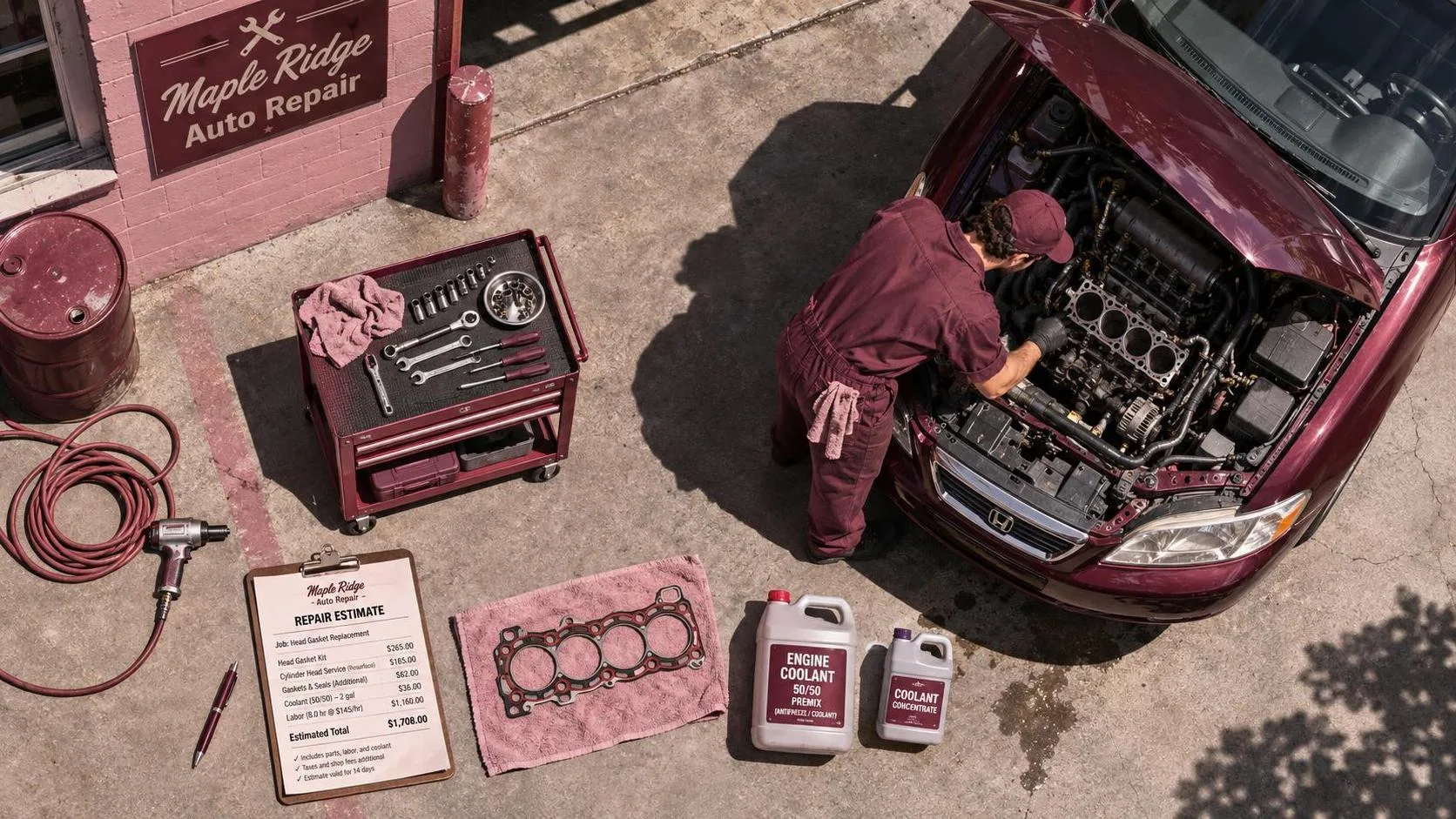
Head Gasket Symptoms, Diagnosis, and Repair
Learn how to recognize head gasket symptoms, check for other causes, and decide when to stop driving or leave the repair to a professional mechanic.
A little white exhaust on a cold morning does not automatically mean your head gasket is blown. Condensation can look dramatic, especially in winter. The stronger warning is a pattern: unexplained coolant loss, overheating, persistent white exhaust after warm-up, or a rough start that accompanies those symptoms. Stop driving if the engine overheats; a proper diagnosis matters before anyone takes the engine apart.
What a head gasket does
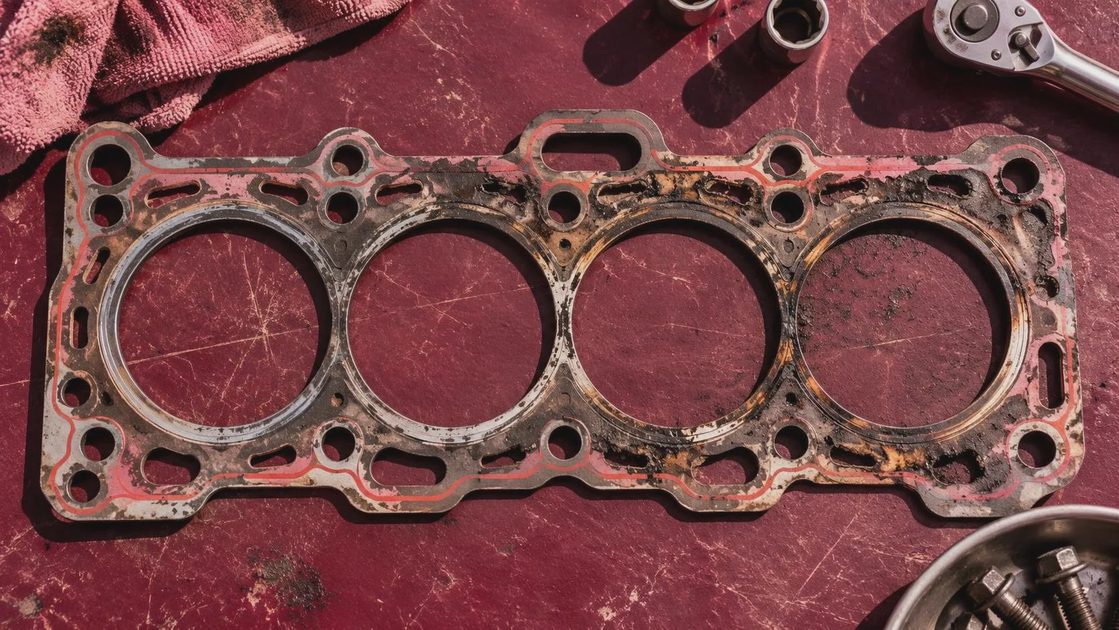
The gasket seals the joint between the engine block and cylinder head. It contains combustion pressure and helps keep coolant and oil in their respective passages. When that seal fails, the result depends on where the leak occurs: combustion gases may enter the cooling system, coolant may enter a cylinder, or fluids may leak externally.
A failed head gasket is serious, but it is not the only cause of an overheating engine. A leaking hose, faulty radiator cap, stuck thermostat, damaged water pump, or cooling fan problem can produce some of the same symptoms. Replacing a gasket without finding the original cause can leave the new repair vulnerable to the same failure.
Symptoms worth investigating
Watch for coolant that repeatedly drops in the reservoir without an obvious external leak. A sweet smell from the exhaust and thick white vapor that continues after the engine reaches operating temperature can suggest coolant is burning. A misfire or rough start after the vehicle has sat may be another clue, although ignition and fuel problems can also cause it.
Combustion gases entering the cooling system can create persistent bubbling in the coolant reservoir. Overheating, unusually firm coolant hoses, and coolant pushed out of the reservoir may accompany it. None of those signs alone proves a head gasket failure; a shop needs to distinguish combustion gas from trapped air or other cooling-system faults.
Milky oil on the dipstick is concerning, but a small amount of pale residue under the oil cap can also result from condensation and short trips. And clean-looking oil does not rule out a failed seal. Oil and coolant do not have to mix for combustion pressure or coolant to escape.
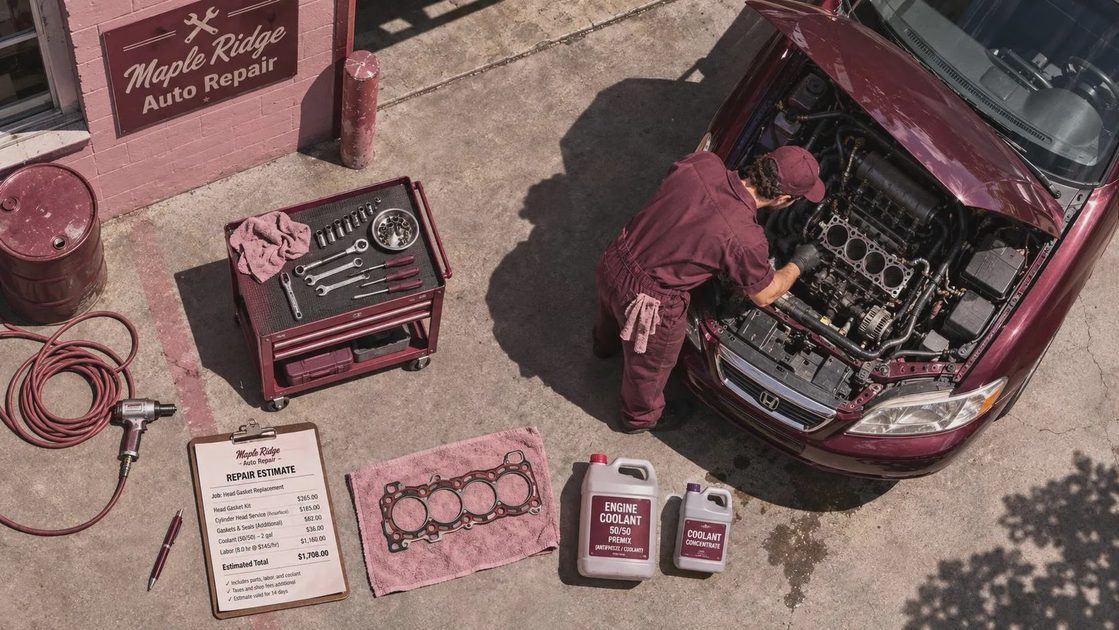
Safety First: What to do before checking
If the temperature gauge climbs into the hot range or an overheating warning appears, turn off the air conditioning, pull over safely, and shut the engine off. Do not keep driving to see if the temperature comes down. Arrange a tow if the engine has overheated or is running badly.
Never remove a radiator cap or pressurized reservoir cap while the engine is hot. Hot coolant and steam can cause severe burns. Let the engine cool completely before touching the cap or inspecting the cooling system. Keep hands, clothing, and tools away from belts and fans; some electric fans can start unexpectedly.
If you suspect coolant has entered a cylinder, do not repeatedly crank the engine. Liquid does not compress like air, and attempting to start an engine with enough liquid in a cylinder can cause major damage. Have it inspected instead.
Tool Check: A basic cold-engine inspection
For an initial look, gather safety glasses, a flashlight, clean paper towels, and the owner's manual. Use the manual to identify the coolant reservoir and the correct cold-level marks. This inspection does not require removing fasteners, so there is no torque specification to apply.
With the engine completely cold and off, check the coolant level at the reservoir. Look around hose connections, the radiator, and beneath the vehicle for wet spots or dried coolant residue. A visible leak is useful evidence, but it does not automatically rule out an internal problem too.
Check the oil dipstick using the procedure in the owner's manual. Note whether the oil looks unusually milky or the level has risen unexpectedly. Record what you find and whether the coolant level changes between cold checks. Do not open a hot cooling system or crawl under a vehicle supported only by a jack.
This is a visual check, not a head gasket test. If you see missing coolant, contaminated oil, or signs of overheating, give those observations to the technician rather than topping off repeatedly and hoping the problem disappears.
How a shop confirms the problem
A technician may pressure-test the cooling system with the engine cool to look for leaks. Depending on the engine and symptoms, that can reveal an external leak or help identify coolant entering a cylinder. A combustion-gas test checks for exhaust gases in the cooling system; the result needs to be interpreted alongside the rest of the inspection.
A compression test or cylinder leak-down test can provide more information about cylinder sealing. A borescope may help reveal coolant or unusual deposits inside a cylinder. These tests are complementary: no single result should be treated as a universal answer for every failure.
Ask the shop what evidence supports its diagnosis and whether it has checked for the cause of the overheating. It may not be possible to assess all damage until the cylinder head is removed. Warping, cracking, and damage to the block or other components can change the scope of the job.
Repair decisions and torque specifications
A head gasket replacement often involves removing intake and exhaust components, timing parts, and the cylinder head. The head and block sealing surfaces need inspection, and a machine shop may need to measure or service the head. The cooling system also needs the underlying fault repaired and the correct refill and bleeding procedure.
Torque to spec — and yes, the spec matters. Cylinder-head bolt torque, tightening sequence, angle turns, lubrication instructions, and whether bolts must be replaced are engine-specific. The same is true for camshaft, timing-component, intake, and exhaust fasteners. There is no safe universal number I can give without the vehicle's year, make, model, engine, and the applicable service procedure. Look up every fastener in the factory service information before beginning; follow its instructions for new bolts and torque-to-yield bolts.
Here's what I see go wrong most often: treating a sealant bottle as a substitute for diagnosis. Some products may be marketed as temporary measures, but they are not equivalent to correcting a failed seal or a damaged engine, and they can complicate cooling-system service.
For an estimate, ask for labor, gasket and bolt costs, machine-shop work, fluids, and how additional damage will be approved. If you lack the service information, precision measuring tools, or experience with engine timing, this is a good job to hand to a qualified shop. You can still do the safe first inspection and bring useful notes. You can do this. Here's the safe, right way.
Comments
No comments yet — be the first to share a thought.